India's Infrastructure Revolution
India has built more infrastructure in the last decade than in the five decades before it combined. This is not a political claim, it is a measurable fact about roads, railways, ports, airports, and digital systems. What it means for the economy, and what is still missing, is the more interesting question.

Founder, Majhi Group & Majhi OS
The road from Junagarh to Bhawanipatna, a stretch I traveled many times as a child, took close to three hours in a bad season. The last time I checked, it takes less than half that. The road is not metaphorical. It is physical bitumen laid on what used to be a surface that punished every vehicle that tried to cross it quickly.
I use this road as a calibration point. When people talk about India's infrastructure story in aggregate terms, I run it against what I have watched happen on a specific stretch in Kalahandi, and that test tells me how real the story is.
India's infrastructure story is best understood in two eras: before 2014 and after. The acceleration is real, the numbers are verifiable, and the causes are structural as well as policy-driven. The more interesting question is what it means.
The physical infrastructure build
Roads: India's national highway network expanded from approximately 91,000 km in 2014 to over 146,000 km by 2024. More importantly, the quality of the network improved substantially, four-laning of key corridors, better surface standards, and a reduction in the time and cost of freight movement that is measurable in the productivity data of businesses that depend on road transport.
The Bharatmala project, a programme to build 34,800 km of new economic corridors, ring roads, and coastal and port connectivity roads, represents the largest highway construction programme India has ever attempted. Execution has been slower than original timelines, but the scale of what has been completed is genuine.
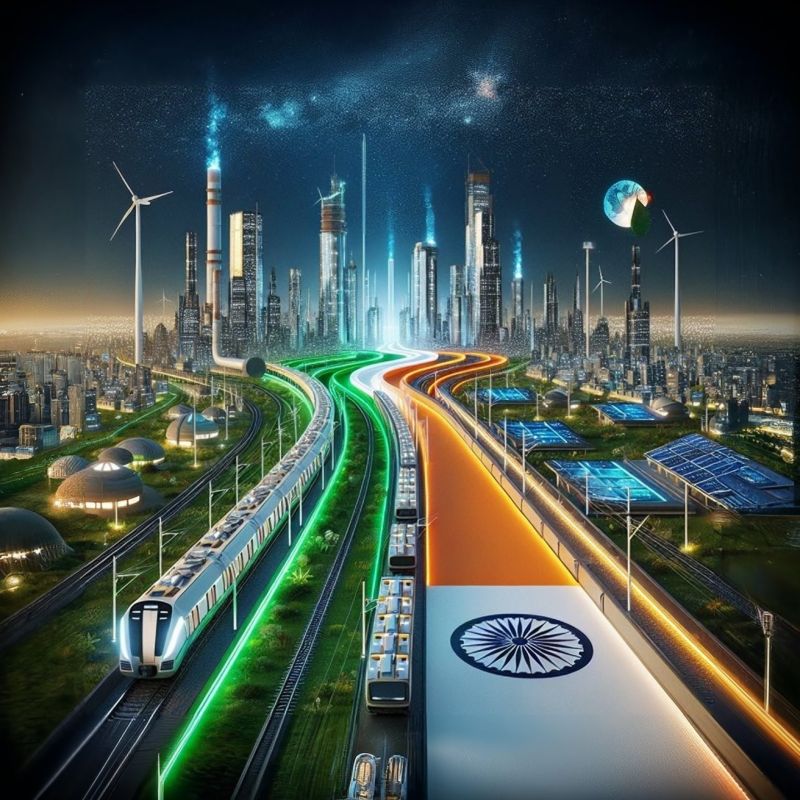
Railways: Indian Railways is in the middle of the most significant capital investment cycle in its history. The Vande Bharat express train programme, electrification of the network (from approximately 35% in 2014 to near-complete by 2025, per Indian Railways Annual Statistical Statements), dedicated freight corridors separating passenger and goods trains, and a station redevelopment programme covering hundreds of facilities. The dedicated freight corridors alone, connecting the industrial clusters of the north and west to the ports of the eastern and western coasts, represent a structural improvement in logistics economics that will take years to fully show up in productivity data.
Airports: India added more airport capacity between 2014 and 2024 than in the previous thirty years combined. New airports at Durgapur, Shirdi, Kannur, Kushinagar, Deoghar. Expansion at virtually every major hub. The Noida International Airport at Jewar, when complete, will be among the largest airports in Asia by capacity. Aviation infrastructure constraints that were binding on India's connectivity story five years ago have been substantially addressed.
Ports: the Sagarmala programme modernised port capacity and connectivity across India's coastline. Mundra, JNPT, and Chennai have all expanded. The logistics infrastructure connecting ports to hinterlands, roads, rail, cold chain, has improved significantly. India's port turnaround times, which were uncompetitive globally a decade ago, have improved to within range of international standards at major facilities.
The digital infrastructure build
The physical infrastructure story is the one that gets the most attention. The digital infrastructure story is arguably more consequential.
UPI: the Unified Payments Interface, launched by NPCI in 2016, processed 172 billion transactions across all of 2024, growing 46% year-on-year, reaching 16.73 billion in December 2024 alone. By ACI Worldwide data, India accounts for approximately 46% of all real-time payment transactions globally. It took eight years to build a payment system that reaches from Mumbai's financial district to a vegetable vendor in Kalahandi. The architecture, interoperable, real-time, effectively free for users, was a deliberate design choice, not a market outcome. It did not happen automatically.
Aadhaar: the biometric identity system that covers over 1.3 billion Indians has become foundational infrastructure for financial inclusion, government service delivery, and increasingly for private sector identity verification. The controversies around Aadhaar are real and worth taking seriously. The infrastructure it provides, a universal, instantly verifiable identity, is genuinely transformative for populations that previously had no formal documentation.
ONDC: the Open Network for Digital Commerce, launched in 2021, attempts to do for e-commerce what UPI did for payments, create an interoperable layer that allows any buyer and seller to transact without being locked into a single platform. It is earlier in its development curve than UPI and the outcome is less certain, but the design intent is the same.
4G and 5G coverage: Jio's entry in 2016 dropped data prices from some of the highest in the world to among the lowest, in one step. The effect on internet penetration was immediate and large. By 2024, India has over 800 million internet users, the majority on mobile. 5G rollout has been aggressive by global standards.
What this infrastructure build enables
The combination of physical and digital infrastructure produces effects that are more than additive.
A road that connects a village to a district town is valuable. A road to a district town in a region with 4G coverage and UPI adoption is substantially more valuable, because the road enables physical mobility and the digital infrastructure enables information mobility and financial transactions simultaneously. The combination changes the economics of small business, formal employment, and market participation for populations that previously had none of these tools.
A road that connects a village to a district town is valuable. A road in a region with 4G coverage and UPI adoption is substantially more valuable. The combination changes the economics of small business for populations that previously had none of these tools.
The logistics cost reduction that flows from better roads, railways, and ports reduces the effective cost of doing business across India, but the benefit concentrates in manufacturing, where logistics costs are a material share of total costs. This is one reason the PLI schemes and the infrastructure build are complementary: the infrastructure makes the manufacturing investment more attractive by reducing a cost that was previously prohibitive.
For talent, the implication is that the geographic constraint on where skilled workers need to be located has loosened. Better connectivity between tier-2 cities and major economic centres reduces the cost of being in a smaller city while accessing opportunities in larger ones. This is early but directional.
What is still missing
The honest account includes what the revolution has not yet delivered.
Last-mile connectivity: the national highway network is transformed. The state highway and district road network is far more variable. The interior of states like Odisha, Chhattisgarh, and Bihar still has significant last-mile connectivity gaps that limit the benefit of national infrastructure investment. The distance between the national highway and a village can be the determining factor in whether the highway's benefits reach that village.
Urban infrastructure: India's metros are under severe pressure from population density that has outrun the infrastructure built to serve it. Mumbai's suburban rail system is near capacity. Delhi's roads add vehicles faster than capacity can be added. Water and sanitation infrastructure across major cities is strained. The infrastructure revolution has been more effective at connecting places to each other than at making individual cities function well at the density they now carry.
Power reliability: India's installed power generation capacity has grown substantially. Transmission and distribution infrastructure has lagged, and power reliability, particularly in industrial contexts, remains a constraint in some regions. The renewable energy build is impressive in aggregate but the grid integration is a continuing challenge.
Institutional infrastructure: physical and digital infrastructure without the institutional infrastructure to use it effectively is less valuable than it appears. Courts that function, contract enforcement that is reliable, regulatory processes that are predictable, these are the institutional infrastructure that determines whether physical infrastructure investment produces private sector activity. India's institutional infrastructure varies widely across states and has improved less uniformly than its physical infrastructure.
The decade from 2014 to 2024 changed India's infrastructure story in ways that are real and significant. The next decade will determine whether that infrastructure is the foundation for a sustained expansion of economic opportunity or whether the institutional and urban gaps limit what it can deliver.
The decade from 2014 to 2024 changed India's infrastructure story in ways that are measurable, verified, and real. The next question is whether the institutional infrastructure catches up to the physical infrastructure. That is the harder build.
Manas Majhi grew up in Junagarh, Kalahandi, Odisha. He writes about opportunity, development, and the systems that fail to distribute either equitably. He is the founder of Majhi Group and Majhi OS.
See also: Why India's Moment Is Now, India's Future in 10 Years, The Future of Indian Cities, From Freedom to Capability
Sources
Ministry of Road Transport and Highways: National highway network data
Indian Railways Annual Statistical Statement: electrification data
NPCI UPI Product Statistics: transaction volume data
UPI 2024 annual transactions: DD News
ACI Worldwide: Prime Time for Real-Time Global Payments Report
Frequently Asked Questions
How much has India's road network expanded in the last decade?
India's national highway network expanded from approximately 91,000 km in 2014 to over 146,000 km by 2024, a 60% increase in a single decade. The quality of the network also improved substantially, with four-laning of key corridors and a reduction in freight movement time. The Bharatmala project represents the largest highway construction program India has ever attempted, targeting 34,800 km of new economic corridors.
What has UPI's growth revealed about India's digital infrastructure build?
UPI is the clearest measure of digital infrastructure success. Launched in 2016, it processed over 172 billion transactions in 2024, growing 46% year-on-year, reaching 16.73 billion in December 2024 alone. By ACI Worldwide data, India accounts for approximately 46% of all real-time payment transactions globally. The architecture, interoperable, real-time, effectively free for users, was a deliberate design choice that no single company could have built with the same incentive structure.
What infrastructure gaps remain despite the revolution?
The honest account includes what the revolution has not yet delivered. Last-mile connectivity: the national highway network is transformed but state highway and district road networks remain variable. Urban infrastructure: metros are under severe pressure from population density that has outrun the infrastructure built to serve it. Power reliability: installed generation capacity has grown substantially but transmission and distribution infrastructure has lagged, particularly for industrial users. Institutional infrastructure: physical and digital infrastructure without the institutional capacity to use it effectively is less valuable than it appears.
Did this land? Push back? Add something I missed?
Reply to Manas →Continue Reading
Related writing
 India
IndiaWhy India's Moment Is Now
India has had inflection points before. This one is different, because for the first time, multiple structural advantages are converging simultaneously: demographic, digital, geopolitical, and institutional. The question is whether the execution matches the opportunity.
 India
IndiaIndia's Future in 10 Years
Projecting India's next decade requires holding two things simultaneously: genuine structural advantages that are real and compounding, and genuine execution risks that have derailed previous inflection points. Both are true. The outcome depends on which one wins.
 India
IndiaThe Future of Indian Cities
Indian cities are being shaped by decisions being made right now. The window to get them right is shorter than most people realize.