Rain, Debt, and Distance
More than 150 years after Odisha's worst famine reshaped who owned the land, over 200,000 people still leave the state's driest districts every year, chasing work the rain still won't guarantee.
Collection
Development, tourism, culture, and the untapped potential of a remarkable state.
28 pieces
More than 150 years after Odisha's worst famine reshaped who owned the land, over 200,000 people still leave the state's driest districts every year, chasing work the rain still won't guarantee.
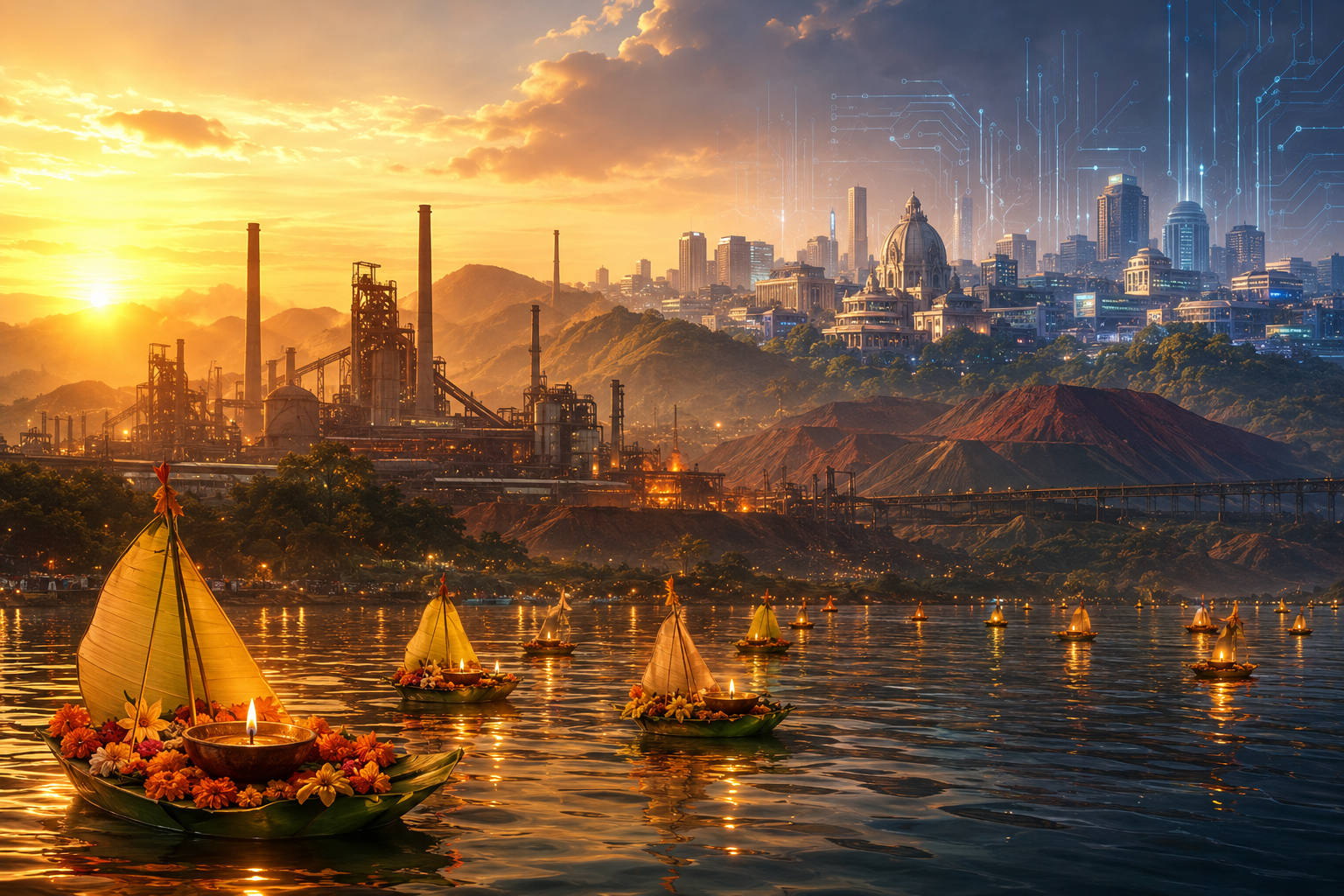
Three ages. Three resources. One coast, one mountain range, one generation. Odisha has had what the world needed every time the world changed what it needed. The first two ages were defined by what the land contained. The third will be defined by what the people decide.
Odisha has subsidized its farmers for three decades. Farm incomes remain among the lowest in India. The problem was never a lack of support, it was the wrong kind of support. Subsidies preserve the status quo. Infrastructure changes it.
Odisha has more river systems, more rainfall, and more coastline than most Indian states. It also floods regularly, irrigates less farmland than the national average, and watched Chhattisgarh build upstream dams on its primary river while it was still deciding what to do about it. This is not a geography problem.
If you grew up in Odisha, you know someone who left. Maybe it was you. What it means to love a place that made you leave, and whether that is beginning to change.
Paradip Port is India's largest port by cargo volume, handling over 150 million metric tonnes annually. It sits on Odisha's coastline, routing the state's mineral wealth to the world. And yet Odisha remains one of India's least economically developed states. That gap between what Paradip handles and what Odisha captures is the central strategic question of Odisha's economic future.
In Tirupur, Tamil Nadu, textile employers are paying a wage premium for workers trained in Odisha. Not as policy. Because the quality is better. That fact, sitting quietly in a textile cluster 1,500 kilometres from Bhubaneswar, is worth spending some time with.
When I was starting my first venture I was running it through VSAT because nothing else reached Junagarh. JioFiber is there now. That compression tells you most of what you need to know about what changed, and what hasn't.
OdishaEvery year, Odisha educates tens of thousands of engineers, doctors, and managers at public expense, and then transfers most of that investment to Bangalore, Hyderabad, and Pune. The scale of this transfer is larger than most people realize.
Odisha is systematically underestimated, not because it lacks substance, but because it lacks the visibility infrastructure that translates substance into perception. The gap between what the state is and what most people believe about it is large and narrowing.
Economic growth is necessary for development. But it is not a definition of it. Odisha has been growing. The harder question is what that growth has actually built.
Odisha has grown faster than the national average for a decade, and most of India hasn't noticed. That gap between performance and perception is itself worth examining, it says something about how economic narratives form, and who gets credit for growth they've already delivered.
Odisha produces more technical and professional talent than its local economy currently absorbs. The result is a diaspora distributed across Indian and global organisations, and a sourcing opportunity for companies willing to look.
Odisha's startup ecosystem is early-stage, and comparing it to Bangalore misses the point. What's worth watching is not whether it catches up to established hubs, it's whether it develops the founding conditions that produce companies the major hubs wouldn't produce.
Odisha's infrastructure has improved faster than the state's reputation has. The mismatch between what exists on the ground and what most people believe about the state is not an accident, it is a narrative set decades ago that hasn't been updated.
Odisha is not yet in the conversation about India's AI ecosystem. It should be. The inputs are strong, technical talent, cost structure, government intent, institutional density. What's missing is capital, senior AI talent, and a visible first win.
Odisha is one of India's most significant manufacturing states, and most people outside the industry don't know it. Steel, aluminium, chemicals, fertilisers, and a growing petrochemical corridor. This is the industrial base that funds everything else.
Odisha has a concentration of temples, wildlife, tribal culture, and coastline that should make it one of India's premier tourism destinations. It isn't, yet. The reasons are fixable. And the trajectory is changing.
The debate in Odisha is Metro vs MRTS. That is the wrong question. The right question is: what transport system does a multi-city $500 billion economy actually need?
India has world-class pharmaceutical clusters in Hyderabad, Pune, and Ahmedabad. Eastern India has none. That gap is also an opening, and Odisha is positioned to claim it.
Two thousand years ago, Kalinga controlled Indian Ocean trade from the eastern coast of India. The geography that made that possible has not changed. What we have done with it has.
More than 30% of Odisha's SGDP comes from mines and minerals. When the reserves run out, and they will, what exactly are we leaving behind?
OdishaBhubaneswar has the talent pipeline, the cost structure, and the infrastructure foundation. The question is whether it can generate the ecosystem gravity that converts those inputs into an AI city.
The state I grew up in shaped how I think about ambition, possibility, and the gap between potential and outcome.
The geography of where you start is more arbitrary than you think. And less limiting than people told me it would be.
For a state that gets most of its press coverage during disasters, there are things it is doing better than the narrative suggests.
When someone from outside sees your home for the first time, you see it differently too.
People sometimes ask why I spend so much time talking about a state most of the world cannot find on a map. The answer is about identity and responsibility.