Salt, Steel, and Silicon
Three ages. Three resources. One coast, one mountain range, one generation. Odisha has had what the world needed every time the world changed what it needed. The first two ages were defined by what the land contained. The third will be defined by what the people decide.

Founder, Majhi Group & Majhi OS
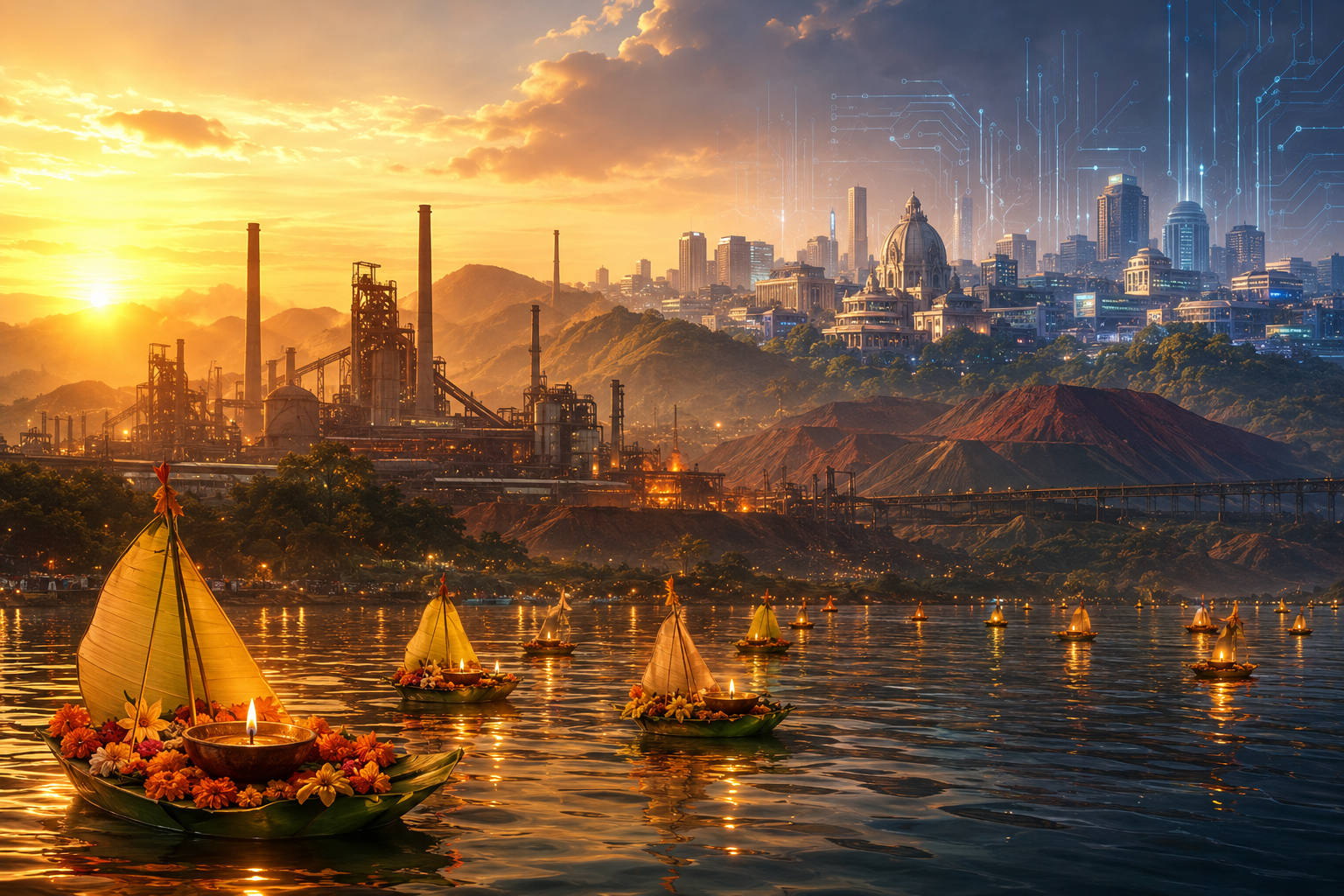
There is a festival in Odisha called Kartika Purnima. On the full moon of November, people walk to the nearest body of water, river, pond, sea, and launch miniature boats made of banana stems and marigolds. The boats carry lit lamps. They float out into the dark.
The ritual remembers something. For centuries, Odia merchants called Sadhabas loaded wooden ships with textiles and spices and pushed off from this same coastline, headed for Bali, for Java, for the ports of what is now Malaysia and Indonesia. They were not traders by accident. They were traders by civilization. The sea was not a border. It was a road.
The sea was not a border. It was a road.
The Bay of Bengal was once called the Kalinga Sagara, the Sea of Kalinga. Not a body of water adjacent to this civilisation. Their sea.
That instinct, to read the landscape and understand what it offers, runs through Odisha's entire history. Three times, the world changed what it needed. Three times, Odisha had it.
The First Age: Salt
Before steel, before software, before any of the abstractions of modern economy, there was salt. The most essential mineral. The one without which food spoils, wounds fester, animals die.
Odisha had 480 kilometres of coast. It had the sun, the wind, and the salt pans of the Mahanadi delta. Salt wasn't a product here, it was a civilisation. The malangis, hereditary salt manufacturers, worked two distinct processes: the panga method, boiling concentrated seawater over fire in iron pans; and the karkatch method, which used nothing but sunlight and time. Ports like Manikapatna were active trading centres from the second century BCE, sending goods westward to Rome, eastward to China, southward to the islands of Southeast Asia. Odisha's maritime merchants, a trading civilisation whose reach across the Indian Ocean goes back two thousand years, carried the products of this coast across the Bay of Bengal in ships that took months to reach their destinations, navigating by stars, by current, by the kind of knowledge that doesn't fit in any textbook.
This is the first layer of what Odisha is. Not just geography. A civilisation that understood the value of what it had and built a trading world around it. The boats that still float on Kartika Purnima are not nostalgia. They are memory. They say: we have done this before. We knew the sea before the sea had a name on a modern map.
The first age ended when the Portuguese arrived in the sixteenth century and systematically dismantled what the Sadhabas had built, controlling the coast from Chittagong to Odisha between 1514 and 1615, cutting indigenous shipping networks at their roots. The sea that had been a road became, for the first time, a barrier.
The Second Age: Steel
The world changed its needs. The industrial age did not run on salt. It ran on iron.
Odisha's western hills, Keonjhar, Sundargarh, the ranges that rise from the plains like the spine of something ancient, turned out to hold one of the largest iron ore deposits in Asia. Not a modest reserve. A geological fortune.
Keonjhar alone accounts for more than 60 percent of the state's iron ore production. The assessed reserves in Keonjhar and Sundargarh run to 4,177 million tonnes. Today, Odisha produces more than 53 percent of every tonne of iron ore that India mines.
More than half the iron that builds modern India comes from these hills.
The steel age arrived. Rourkela rose, one of India's first integrated steel plants, its foundation stone laid in 1955 and built with German technical collaboration, Krupp of Germany, on 7,700 hectares of forest and farmland. The same industrial firm that had helped rebuild postwar Europe brought its blast furnace expertise to the banks of the Brahmani river. First steel poured in 1959. What began at a capacity of one million tonnes annually now produces 4.5 million tonnes of hot metal a year.
What Odisha's mountains held became real in the world elsewhere, in bridges, in rail lines, in the frameworks of buildings that people walk through every day without knowing what they're made of or where it came from. The ore traveled out as ore. It came back as modernity.
The ore traveled out as ore. It came back as modernity.
The people who lived near those mines and plants understood something that never quite made it into the official story: that the hills their grandparents farmed were, quietly, holding up the world. There is a particular kind of pride in that knowledge. Unannounced. Unremarked upon. But real.
This land holds the world. It always has.
The Third Age: Silicon
Here is where the story turns.
Salt was fixed in the coastal geography. Iron ore was fixed in the western hills. Neither had a choice about where it was or what happened to it. The mineral economy is a geography economy. You are what your land contains.
Silicon, the third age, is not really about silicon at all. It is a metaphor for intelligence. For the ability to build systems, to write code, to identify problems and engineer solutions, to create things that did not exist before. The intelligence economy does not run on what's in the ground. It runs on what's in people.
And Odisha has been producing it for decades.
NIT Rourkela. IIT Bhubaneswar. KIIT. Together they produce thousands of engineers every year, the third-age resource, packaged and ready. The product is excellent. The problem has always been the direction of travel.
The engineers, the doctors, the researchers, the founders, Odisha sends them everywhere. They left because that's where the infrastructure was. That's where the capital was. That's where the networks were.
But something is shifting.
The infrastructure for building is no longer as fixed as it once was. Odisha now has more than 750 acres of ready IT infrastructure, nine government-notified IT towers, six private IT towers, six software technology parks. There are 139 startups operating in Bhubaneswar. The state is positioning for semiconductor skills, AI integration, fintech. The third-age resource is beginning to accumulate locally rather than flowing out wholesale.
You can write code from Bhubaneswar that runs in San Francisco. You can build a company from Rourkela that serves clients in Dubai. The geographic lock on opportunity is loosening, not gone, but loosening. And in that loosening is a question that the third age keeps asking:
What happens when the silicon stays?
The Question of This Age
Salt couldn't choose. The ore couldn't choose. But the person building a company at 28, the researcher finishing a doctorate, the engineer three years into a career that could go anywhere, they can choose.
The first two ages of Odisha's economy were defined by what the land contained. The third age will be defined by what the people decide.
The first two ages were defined by what the land contained. The third age will be defined by what the people decide.
This is new territory. There is no historical template for it. The Sadhabas who launched their ships on the November sea didn't have a template either. They had a coastline, a sense of what the world beyond it might offer, and the willingness to go find out.
The boats on Kartika Purnima still float. The lamps still burn.
The question is not whether Odisha has what the third age needs. It clearly does. The question is whether the people who carry it will build here, or whether, like salt and iron ore before them, they will enrich the places they travel to while the source stays unchanged.
That is the only question that matters now. And unlike salt, unlike ore, this one has an answer that people can write themselves.
See also: What Kalinga Knew About the Indian Ocean, Odisha's Resource Trap, What Odisha Loses When Its Graduates Leave, The Odyssey of Odisha, Odisha Manufacturing: India's Industrial Base
Sources
R.C. Majumdar: Ancient Indian Colonisation in South-East Asia (Baroda University)
India Brand Equity Foundation: Odisha State Profile: Mining and Minerals
Indian Bureau of Mines: Mineral Yearbook: Iron Ore, Odisha
Ministry of Steel, Government of India: Annual Report on Steel Production
Steel Authority of India (SAIL): Rourkela Steel Plant
Odisha Computer Application Centre (OCAC): IT Infrastructure and Startup Ecosystem
Startup Odisha: State Startup Ecosystem Report
McKinsey Global Institute: India's Turning Point: An Economic Agenda for the Decade
Frequently Asked Questions
What are the three economic ages of Odisha?
The essay identifies three ages: Salt (the ancient coastal economy, built on Odisha's 480km coastline and the maritime trading tradition of the Sadhabas), Steel (the industrial age anchored by Odisha's enormous iron ore deposits in Keonjhar and Sundargarh, and the establishment of the Rourkela Steel Plant in 1954), and Silicon (the intelligence economy, the current age defined not by minerals but by human capital, talent, and the ability to build technology from anywhere).
Who were the Sadhabas?
The Sadhabas were ancient Odia maritime merchants who sailed across the Bay of Bengal to Southeast Asia, to Bali, Java, and ports across what is now Malaysia and Indonesia. They traded textiles, spices, rice, and other goods. Their voyages are commemorated in the festival of Kartika Purnima, when Odia families launch small illuminated boats on rivers and the sea, symbolically re-enacting those departures. The Sadhabas represent Odisha's oldest identity as a seafaring, trading civilization.
What is the Rourkela Steel Plant and why does it matter for Odisha?
The Rourkela Steel Plant, established in 1954, was one of India's first integrated steel plants, built with German technical collaboration. It was constructed in what had largely been forest and farmland in western Odisha, powered by the region's vast iron ore reserves. The plant represented the industrial age arriving in Odisha, transforming the mineral wealth of the western hills into modern infrastructure. It remains one of the largest steel plants in India.
What does 'Silicon' mean in this context, is this about technology companies in Odisha?
Silicon in the essay is a metaphor, not a literal reference to chip manufacturing. It represents the intelligence economy, the engineers, researchers, founders, and builders that Odisha produces. Odisha has been generating this human capital for decades, but most of it has been exported to other cities and countries. The essay asks what changes when that talent chooses to build in Odisha rather than elsewhere, and argues that unlike salt and iron ore, human capital has agency. It can choose.
Did this land? Push back? Add something I missed?
Reply to Manas →Continue Reading
Related writing
 Odisha
What Odisha Loses When Its Graduates Leave
Every year, Odisha educates tens of thousands of engineers, doctors, and managers at public expense, and then transfers most of that investment to Bangalore, Hyderabad, and Pune. The scale of this transfer is larger than most people realize.
 Odisha
The Odyssey of Odisha
If you grew up in Odisha, you know someone who left. Maybe it was you. What it means to love a place that made you leave, and whether that is beginning to change.
 Odisha
Paradip: The Port Odisha Has Not Captured
Paradip Port is India's largest port by cargo volume, handling over 150 million metric tonnes annually. It sits on Odisha's coastline, routing the state's mineral wealth to the world. And yet Odisha remains one of India's least economically developed states. That gap between what Paradip handles and what Odisha captures is the central strategic question of Odisha's economic future.