Why Odisha Matters
Odisha is not an afterthought in India's story. It is one of the original chapters. Understanding why it matters, historically, economically, and now, requires looking at the state on its own terms rather than through the lens of what it's not yet.

Founder, Majhi Group & Majhi OS

When I talk about Odisha to people who don't know it, I am not doing regional promotion. I am describing a place that has shaped how I think about almost everything that matters to me, opportunity, systems, what gets built where and why, who benefits and who doesn't.
I grew up in Kalahandi. I built companies from this state. The question of why Odisha matters is not abstract to me.
What matters about Odisha is not its size, its tourism, or its minerals. It is what it demonstrates about what is possible when a place is taken seriously.
The historical claim
Odisha has one of the oldest and most distinctive civilisational identities in the Indian subcontinent. The Kalinga empire, which controlled much of the eastern coast of India and projected maritime power across Southeast Asia, was centred here. The Kalinga War in 261 BCE, the battle that transformed Ashoka's imperial ambitions into one of history's most significant ethical reckonings, was fought here. The temples of Odisha's Golden Triangle (Bhubaneswar, Puri, Konark) represent one of the most coherent concentrations of pre-medieval Hindu temple architecture anywhere in the world.
This historical depth matters because it shapes the identity of a place. Odisha is not a colonial construction or an administrative convenience. It is a civilisation with a long memory of its own significance. That self-understanding is part of why Odia people tend to carry a quiet confidence about where they're from, even when the rest of India hasn't caught up to it.
The resource position
India's economic development increasingly runs on Odisha's endowment. The state holds approximately 34% of India's iron ore reserves, 98% of its chromite, and significant proportions of its coal, bauxite, manganese, and nickel. The steel industry that supplies Indian manufacturing, and increasingly, global markets, is substantially dependent on Odisha's mineral base.
This resource position would matter in any era. In an era where infrastructure buildout, renewable energy manufacturing, and global supply chain diversification are placing unprecedented demand on raw materials, it matters more. The port infrastructure at Paradip and Dhamra is positioned to export this endowment at scale. The Odisha government has been deliberately building the policy and physical infrastructure to capture more of the value chain rather than exporting raw materials at the bottom of the value curve.
The coastal position
India's coastline is an asset that the country is only beginning to use at its potential. Odisha's 480-kilometre coast gives it access to Bay of Bengal trade routes that connect eastern India to Southeast Asia, East Africa, and the Gulf. Paradip Port is already one of India's largest. The Sagarmala initiative, the national program to develop port-led industrialisation, has significant Odisha investments in its current phase.
The eastern coast of India has historically been undersourced relative to the western coast. That gap is closing. When it does, the states with significant coastal infrastructure and manufacturing capacity will be positioned differently than they are today. Odisha is building toward that position.
The talent output
KIIT University in Bhubaneswar is one of India's largest private universities by enrollment. IIT Bhubaneswar, NIT Rourkela, and IIIT Bhubaneswar add significant technical institution density. The state produces a large volume of engineering and technical graduates annually, more than the current local economy fully absorbs, which means much of this talent has been dispersed to Bengaluru, Hyderabad, Pune, and beyond.
That dispersal is not entirely a loss. It means there is a substantial Odia diaspora in Indian and global technology companies, engineers, managers, and founders who carry a connection to the state and who represent a potential resource for companies willing to invest in recruiting from and building in Odisha.
Why now
The convergence of several trends is making Odisha more relevant, faster, than at any point in recent decades. Industrial investment is accelerating, Tata Steel, JSW, POSCO, and other major manufacturers have significant Odisha operations. The port infrastructure is expanding. The government's investor-friendly positioning has improved the business environment. The Smart City investment in Bhubaneswar is producing visible urban quality improvements.
The state is not there yet. The gap between what Odisha has and what it has made of what it has is still real and significant. But the direction is clearer than it has been, and the inputs for a different trajectory are in place in a way they weren't a generation ago.
Odisha matters because of what it has always been. It is beginning to matter for what it is becoming.
See also: Beyond GDP: What a Developed Odisha Must Be Answerable For, Why Is Odisha Underrated?, Paradip: The Port That Odisha Has Not Yet Figured Out How to Use
Sources
McKinsey Global Institute: India's Turning Point: An Economic Agenda for the Decade
India Brand Equity Foundation: Odisha State Profile
Observer Research Foundation: Odisha's Development Trajectory
Frequently Asked Questions
Why does Odisha matter to India's development?
Odisha matters to India's development for several compounding reasons: it holds the largest reserves of chromite, nickel, and manganese in India and significant coal and iron ore deposits that feed the country's steel sector; it has India's longest coastline on the eastern seaboard after Andhra Pradesh with deep-water port capacity at Paradip and Dhamra; it borders five states, making it a logistics pivot for central and eastern India; and its tribal communities represent a significant portion of India's most economically excluded population, meaning Odisha's development trajectory has outsized implications for India's human development averages.
What is Odisha known for internationally?
Internationally, Odisha is known primarily for its cultural heritage: the Jagannath Temple at Puri (one of the four dhams of Hinduism), the Konark Sun Temple (a UNESCO World Heritage Site), Odissi classical dance, and Pattachitra and other traditional arts. In economic contexts, it is known for steel production (ArcelorMittal Nippon Steel and Tata Steel have major plants) and mineral resources. The state has hosted the Hockey World Cup and FIH series, gaining international sports visibility. It is less known, though increasingly so, for its growing IT sector in Bhubaneswar.
What is Odisha's population and economy size?
Odisha has a population of approximately 46 million people (2024 estimate), making it India's eleventh most populous state. Its SGDP (State Gross Domestic Product) has grown consistently above the national average, driven by industrial production. The state ranks mid-tier among Indian states on per capita income, ahead of Bihar and UP but behind states like Karnataka, Maharashtra, and Gujarat. Bhubaneswar, the capital and largest city, has a population of approximately 1.2 million and is growing rapidly as an IT and services hub.
Did this land? Push back? Add something I missed?
Reply to Manas →Continue Reading
Related writing
 Odisha
Salt, Steel, and Silicon
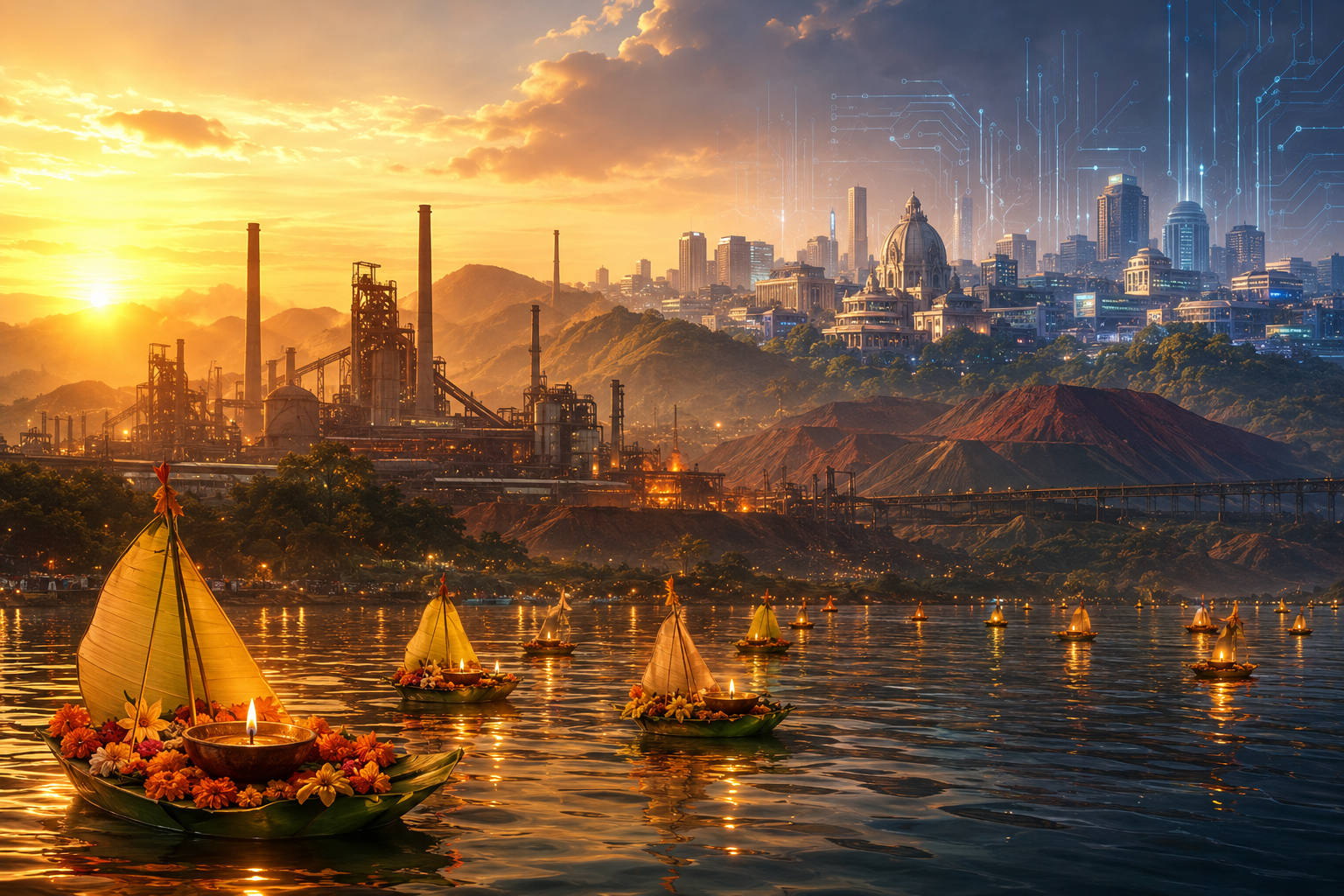
Three ages. Three resources. One coast, one mountain range, one generation. Odisha has had what the world needed every time the world changed what it needed. The first two ages were defined by what the land contained. The third will be defined by what the people decide.
 Odisha
Paradip: The Port Odisha Has Not Captured
Paradip Port is India's largest port by cargo volume, handling over 150 million metric tonnes annually. It sits on Odisha's coastline, routing the state's mineral wealth to the world. And yet Odisha remains one of India's least economically developed states. That gap between what Paradip handles and what Odisha captures is the central strategic question of Odisha's economic future.
 Odisha
Beyond GDP: What a Developed Odisha Must Be Answerable For
Economic growth is necessary for development. But it is not a definition of it. Odisha has been growing. The harder question is what that growth has actually built.