India's Greatest Asset Is Its People
The demographic dividend is real. But dividends require investment, and India's human capital investment remains unequal.

Founder, Majhi Group & Majhi OS
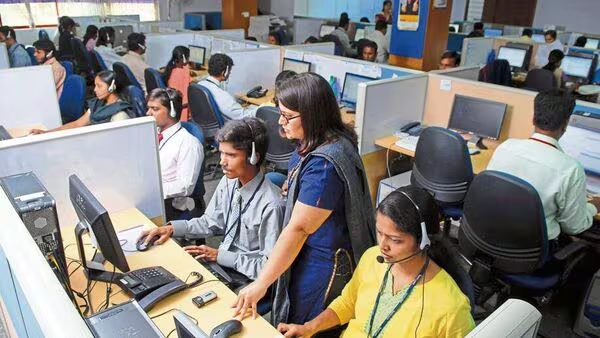
My mother is a teacher. She has spent her career in a government school in a district that most education researchers would classify as underserved. I have watched her work for decades, the specific work of meeting children where they are and moving them forward. The individual attention she gave students who arrived behind. The patience she extended to children who were afraid of school.
That is what India's greatest asset actually looks like up close. Not a demographic statistic. A teacher and a child.
India is in the middle of a demographic transition that no other major country will experience at this scale again.
India's working-age population will reach 68.9% of the total population by 2030, the highest share ever recorded, while the dependency ratio hits its lowest point at 31.2%. The demographic dividend phase is projected to last until 2055, peaking around 2041. Over the next 30 years, India will contribute 22% of global workforce growth, a scale no other single country comes close to matching.
India's working-age population peaks at 68.9% by 2030. The demographic dividend lasts until 2055. India will contribute 22% of global workforce growth over the next 30 years.
The question is not whether India has this asset. It does. The question is whether India is investing in it adequately.
The answer, at present, is mixed.
The investment gap
India spends approximately 2.9% of GDP on education, below the global average and well short of the 6% target set by the National Education Policy 2020. The quality of that spending varies enormously by geography, with urban institutions consistently outperforming rural ones.
The result is a bifurcated human capital stock. A relatively small number of highly educated, globally competitive graduates emerging from elite institutions. And a much larger number of young people with incomplete education, limited skills, and uncertain economic futures.
This is not an abstract problem. It is a concrete waste of an asset that is finite and time-limited.
The demographic dividend does not last forever. Countries that fail to invest in human capital during the transition often miss the window and face a different kind of demographic problem, an ageing population without the economic base to support it. The fuller case for what India must do with this window is the subject of opportunity and mobility in modern India.
India spends 2.9% of GDP on education - well below the 6% target of NEP 2020, and below the global average of 4.9%. The gap between the asset and the investment in it is the defining challenge.
What investment actually means
In my primary school years, I was afraid to go to school. I was not doing well. The gaps from my earliest years made each new class harder to follow.
Kamala Mam, one of my teachers, noticed. She sat with me one day and talked for a long time. She said: if you don't understand something, come to me directly. Don't sit with the confusion.
When we first started working together I was in class three but performing below it. She worked, patiently and without fanfare, to bring me up to standard. Not to pass me through, to actually close the gap.
I don't know what my trajectory would have looked like without that. I know it would have been different.
That is what investment in people actually means. Not a statistic. Not a policy line. One teacher, one student, one conversation that changed what was possible.
When I say India needs to invest in its people, I am not talking only about spending on schools, though that matters.
I am talking about access to quality information. The ability to find, evaluate, and use information is one of the most powerful economic capabilities a person can have. India's connectivity revolution is creating this access for the first time at scale. The question is whether the ecosystem of information, in Indian languages, at appropriate literacy levels, addressing relevant problems, is being built alongside the infrastructure.
I am talking about access to networks. My HOD was a single point of contact, an ex-Air Force officer who had decided that a student who arrived not knowing anyone was not going to stay lost. Most students don't get that. Most networks remain behind doors that only open if you already know someone inside. Economic mobility is driven in significant part by exactly this: who knows what you are capable of, and whether they have the standing to do something about it.
I am talking about access to capital, not just financial capital, but social and institutional capital. The ability to take a risk, to start something, to invest in oneself over a long time horizon requires a baseline of security that many of India's young people do not have. Not because they lack ambition. Because the margin for error is too thin.
The return on investment
I want to be clear about the stakes.
The economic returns to human capital investment in a country with India's demographic profile are exceptional. The research is unambiguous on this. Every rupee invested in quality education, health, and economic inclusion generates returns that compound over decades.
More than the economic returns: the human returns. A person who found no path forward, who found one. A career that would not have existed, that did. A life that opened up because someone, a policy, an institution, a technology, created access where none existed before.
Kamala Mam sat with a child who was afraid of school and worked, patiently, to close the gap. She was one teacher. That kind of deliberate investment, in a child who was behind, in a student who arrived not knowing anyone, in a young person whose potential had not yet had a system to express itself through, should not be a matter of luck. The country that makes it systematic rather than sporadic will have an economy that grows in a way no current forecast captures.
India's greatest asset is its people. The question is whether the systems being built around them are worthy of what they are capable of.
The country that makes it systematic - finding the capable people, providing access where none existed, investing in the margin of error that ambition requires - will have an economy that grows in a way no current forecast captures.
See also: Why India's Moment Is Now, Building for a Billion People, How 4G Changed India
Sources
Vajira Mandrav: India's Demographic Dividend
Frequently Asked Questions
What is India's demographic dividend?
India's working-age population will reach 68.9% of the total population by 2030, its highest ever. The demographic dividend phase is projected to last until 2055. India will contribute 22% of global workforce growth over the next 30 years. But dividends require investment, which remains unequal.
How much does India spend on education?
India spends approximately 2.9% of GDP on education, below the global average and well short of the 6% target set by the National Education Policy 2020. The quality of that spending varies enormously by geography, with urban institutions consistently outperforming rural ones.
Why does the demographic dividend matter for India?
Countries that successfully convert a young population into a productive workforce experience transformative sustained growth. Countries that fail to invest in human capital during the transition miss the window and face an aging population without the economic base to support it. India's window is open until roughly 2055.
Did this land? Push back? Add something I missed?
Reply to Manas →Continue Reading
Related writing
 India
IndiaAI Adoption in Rural India
India's AI story is being written in Bengaluru and Mumbai. The more important story, the one that determines whether AI expands or concentrates opportunity in India, is being written in the districts that the first wave of technology only partially reached.
 India
IndiaWhy India's Moment Is Now
India has had inflection points before. This one is different, because for the first time, multiple structural advantages are converging simultaneously: demographic, digital, geopolitical, and institutional. The question is whether the execution matches the opportunity.
 India
IndiaFrom Freedom to Capability
India did not simply move from poverty to prosperity after 1947. It moved from dependence toward capability, one institution, one dam, one steel plant, one satellite at a time. The next chapter is not about building more of it. It is about unlocking what has already been built.