What Kalahandi Sits On
Kalahandi has significant mineral wealth, bauxite, iron ore, graphite, limestone. For most of its history, those minerals have left as raw material and returned as finished goods made elsewhere. The question of who benefits from a district's natural endowments is one of the oldest questions in development economics. Kalahandi is still answering it.

Founder, Majhi Group & Majhi OS
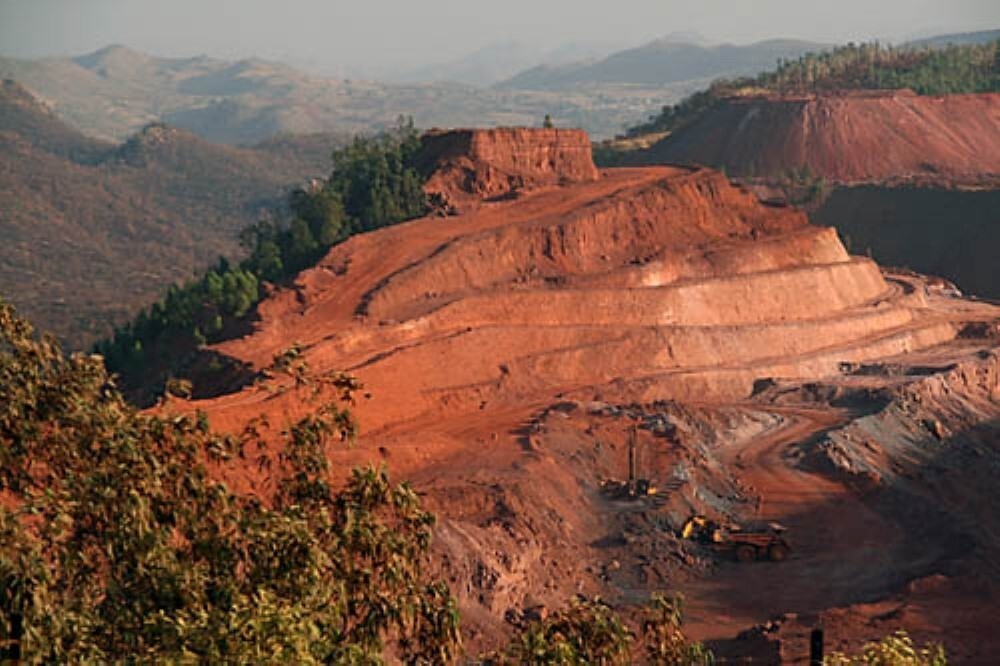
I grew up in Kalahandi knowing that the hills nearby had something valuable in them. The trucks made it obvious, long convoys moving raw material out of the district toward refineries in other places. As a child I did not have the economic vocabulary for what I was watching. What I had was the observation: things of value were leaving, and the people near them were not becoming more prosperous.
There is an old question in development economics that keeps reappearing in different places and different centuries: when a territory has natural resources, who actually benefits?
The question sounds abstract. Kalahandi makes it concrete.
The district has bauxite. It has iron ore. It has graphite, limestone, quartz. The Niyamgiri Hills, which rise from the landscape near Lanjigarh, contain one of the significant bauxite deposits in eastern India. By any standard measure of natural endowment, Kalahandi is a wealthy district.
By standard measures of human development, it is not.
That gap is not accidental. It is the predictable result of a resource extraction model in which minerals leave a territory as raw material and economic value is added somewhere else, in the refinery, in the manufacturing plant, in the city where the finished product is sold. The district provides the inputs. It does not capture the output.
The district provides the inputs. It does not capture the output. That gap is not accidental - it is the predictable result of a resource extraction model in which economic value is added somewhere else.
Understanding this pattern is important not because it leads to easy solutions, but because it identifies the right problem. The question is not whether Kalahandi has resources. It does. The question is whether Kalahandi can capture the value those resources represent.
What the ground holds
Kalahandi sits on geological formations that extend across the mineral belt of western Odisha, a region whose endowments in bauxite, iron ore, coal, chromite, and manganese make Odisha one of the most mineral-rich states in India.
Bauxite is the most contested of Kalahandi's resources. The Niyamgiri Hills area holds deposits that attracted Vedanta Resources' attention in the early 2000s, when the company built an alumina refinery at Lanjigarh in Kalahandi district, planning to use Niyamgiri bauxite as the feedstock. What happened next is one of the most significant legal and environmental stories in modern Indian history.
Iron ore occurs in parts of Kalahandi, though the district's deposits are less significant than the massive concentrations in Keonjhar and Sundargarh. Graphite deposits are present. Limestone, which has uses in cement manufacturing and agriculture, is found in parts of the district. Quartz occurs across western Odisha.
This is not a poor geological inheritance. The district's problem is not what it has underground. The problem is what happens next.
The Niyamgiri story
The Niyamgiri Hills are sacred. Not in the tourist-brochure sense of "culturally significant," but in the deeper sense of a community's entire relationship with a landscape, the way it understands identity, ancestry, and the world, being organized around these hills.
The Dongria Kondh, a sub-group of the Kondh tribal people who have inhabited these hills for as long as oral history reaches, call the hills their home in a way that is not metaphorical. Niyam Raja, the deity of the hills, is not a deity worshipped in a temple somewhere else. The deity is the hills themselves. The streams that run from the hills, the forests that cover them, the specific geography of the ridges and valleys, these are the sacred geography in which Kondh life is organized.
Vedanta Resources, which had built the Lanjigarh alumina refinery in anticipation of Niyamgiri bauxite, applied for environmental clearance to mine the hills. The Kondh opposed the mining. What followed was a decade of legal proceedings, environmental reviews, political controversy, and international attention that eventually reached the Supreme Court of India.
In 2013, the Supreme Court issued a judgment that is worth understanding carefully. The Court did not simply rule for or against mining. It ruled that the gram sabhas, the village assemblies of the communities directly affected, had the right to decide whether the mining could proceed, based on the Forest Rights Act of 2006 and constitutional protections for tribal communities.
Twelve gram sabhas voted. All twelve voted against allowing the mining. Niyamgiri remains unmined.
I want to say something about this outcome that is neither a simple environmental celebration nor a dismissal of the economic arguments.
The Kondh communities exercised a legal right that was hard-won, the right to decide what happens to a landscape that is theirs in a way that predates the state's authority to grant or revoke licenses. That is significant. The Forest Rights Act and the Supreme Court's interpretation of it in the Niyamgiri case established a precedent: that tribal communities have genuine veto power over extraction on their traditional land, not merely a consultative role.
That precedent matters beyond Kalahandi. It matters for how India resolves the tension between mineral development ambitions and the rights of the communities who live closest to those minerals.
The extraction model's math
Here is a way to think about the economics of mineral extraction in places like Kalahandi.
When bauxite leaves Kalahandi as ore, the value of that transaction, the price the company pays for the mineral at the mine, is relatively low per unit. The high-value operations are aluminium smelting (which requires enormous quantities of electricity), aluminium fabrication (which produces the rolled sheets and extrusions used in aircraft, vehicles, buildings, and electronics), and final manufactured products.
An alumina refinery at Lanjigarh creates jobs in Kalahandi. So does a mine, if it operates. But the total employment and income generated by the alumina refining step alone is a fraction of what the full aluminium value chain, from bauxite to finished automotive or aerospace parts, would generate.
Most of that value chain does not exist in Kalahandi. It exists in the places that buy the alumina and process it further.
My position on this is direct: I believe that when a natural resource comes from a place, the case for processing it in that place is strong, not just ethically but economically. Value addition in the district of origin means jobs, skill development, tax revenue, and the infrastructure investment that follows employer concentration. Export of raw material means none of that.
This is not a new argument. It is the argument that Norway made about oil, that Botswana made about diamonds, that Chile made about copper. Countries and territories that insisted on value-addition within their borders before permitting export created fundamentally different economic trajectories than those that accepted the pure extraction model.
I have said it plainly before: if you want Odisha's minerals, you should have to process them in Odisha. The same principle applies at the district level. If you want Kalahandi's bauxite, you should employ Kalahandi's people in turning it into something more than ore.
What this would actually require
The processing-first principle is simple to state and complex to implement.
Aluminium smelting requires prodigious electricity, around 13-15 kilowatt-hours per kilogram of aluminium, which is why aluminium smelters locate near hydroelectric power in Norway and Iceland rather than near bauxite mines in tropical countries. Without cheap, abundant power, aluminium smelting in Kalahandi is not economically viable regardless of policy.
This is the real constraint. And it points to the companion infrastructure investment that would need to accompany any serious value-addition strategy: power generation at competitive industrial rates. The same power investment that would enable mineral processing would also enable data centers, manufacturing, and the broader economic activity that Kalahandi needs.
These are chicken-and-egg problems, power investment is easier to justify when there are large industrial consumers, and large industrial consumers are easier to attract when power is cheap and reliable. Breaking that cycle requires deliberate policy and patient capital.
It is not impossible. Odisha has improved its power sector capacity substantially over the past decade. The question is whether that improved capacity reaches Kalahandi at industrial rates, and whether state policy actively directs mineral value addition toward the districts of origin.
The opportunity
The most straightforward opportunity statement is this: Kalahandi has natural assets. It does not have the infrastructure to fully capture the value of those assets. The gap between those two conditions is an opportunity, for investment, for policy, for the kind of patient institution-building that turns resource endowment into human development.
That opportunity will not be seized automatically. It requires people willing to name the gap, build in the district, and advocate for the policy conditions that make value-addition viable.
I am from Kalahandi. I want to see this district captured on the world map, not as a source of raw materials for someone else's manufacturing base, but as a place that processes its own endowments and retains the value they represent.
That's a different future than the one the extraction model produces. It is also the only future that changes Kalahandi's development trajectory in the long run.
When a natural resource comes from a place, the case for processing it in that place is strong - not just ethically but economically. Value addition in the district of origin means jobs, skill development, tax revenue, and the infrastructure investment that follows employer concentration.
Manas Majhi grew up in Junagarh, Kalahandi, Odisha. He writes about opportunity, development, and the systems that fail to distribute either equitably. He is the founder of Majhi Group and Majhi OS.
See also: The Water Paradox: Why Kalahandi's Farms Fail When the Rivers Are Full, Why It Costs Rs.3,000 to Fly to Kalahandi, What Development Actually Looks Like in Kalahandi
Sources
Frequently Asked Questions
What minerals are found in Kalahandi?
Kalahandi has significant deposits of bauxite (particularly in the Niyamgiri Hills area), iron ore, graphite, limestone, and quartz. The district sits on the eastern part of the Deccan plateau geological formation, which is mineral-rich across much of western and southern Odisha. Bauxite, the ore from which aluminium is refined, has been the most contested resource, given the long legal and political battle over the Niyamgiri Hills.
What happened with the Vedanta mining case in Kalahandi?
Vedanta Resources sought to mine bauxite from the Niyamgiri Hills in Kalahandi's Lanjigarh area, adjacent to their alumina refinery at Lanjigarh. The Dongria Kondh tribal community, for whom Niyamgiri Hills are sacred, opposed the mining. After years of legal battles, the Supreme Court of India in 2013 ruled that gram sabhas (village assemblies) of the affected communities must consent to the project. The gram sabhas voted against allowing the mining. The Niyamgiri Hills remain unmined.
Why does Kalahandi remain poor despite having mineral wealth?
Mineral wealth and local prosperity are not the same thing, and Kalahandi is a clear example of why. When minerals are extracted and exported as raw material, the economic value added, refining, manufacturing, jobs at higher skill levels, happens elsewhere. The district gets the environmental disruption of extraction without capturing the industrial value chain. Changing this requires deliberate policy to link extraction to local processing, which is politically difficult and economically complex but economically transformative when it works.
What is the Niyamgiri Hills controversy?
The Niyamgiri Hills are a forested range in Kalahandi and Rayagada districts, sacred to the Dongria Kondh tribal community, who call the hills their ancestral home and worship a deity, Niyam Raja, associated with the hills. Vedanta Resources sought to mine the bauxite deposits in these hills to feed their alumina refinery in Lanjigarh. The Supreme Court ruled in 2013 that affected communities had the right to decide. The gram sabhas said no, and mining has not proceeded. The case became internationally significant as a landmark in tribal rights and environmental law.
Did this land? Push back? Add something I missed?
Reply to Manas →Continue Reading
Related writing
 Kalahandi
Kalahandi Agriculture: The Water Paradox
Kalahandi has rivers. It has rainfall. It has fertile soil. It has everything a farming region needs, except the infrastructure to turn rainfall into reliable harvests. That gap between what the land has and what the land produces is one of the most fixable problems in Indian agriculture. And one of the least fixed.
 Kalahandi
Why It Costs Rs.3,000 to Fly to Kalahandi
The cheapest flight in India costs Rs.400. The flight to Kalahandi costs Rs.3,000. Same flight time. Seven times the price. That gap is not about aviation economics. It's about how India decides which places get to participate in the modern economy.
 Kalahandi
Kalahandi's History Is Not What You Think It Is
For most people, Kalahandi's history begins and ends with the 1985 famine. That is like knowing Britain only through the Blitz. A place is not its worst decade. Kalahandi is ancient, complex, and has been building itself, quietly, for a very long time.